The Market Shift: Value Over Volume
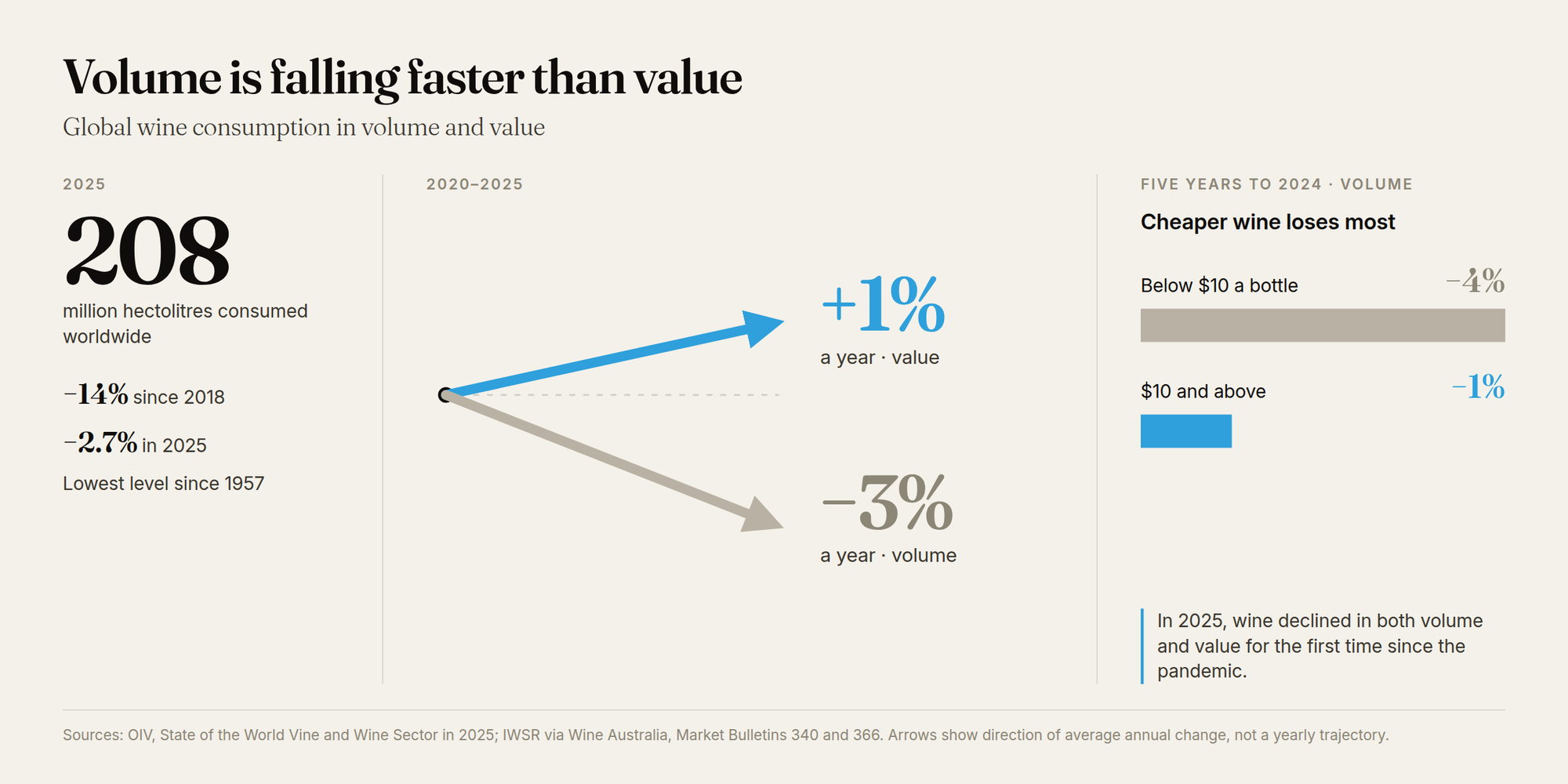
Global wine consumption has declined by almost 14% since 2018, with consumption declining by 2.7% in 2025. Younger generations are drinking significantly less, while moderation is expanding across all age groups, posing a real threat to traditional volume-led business models.
Yet the picture is not entirely gloomy. Volume has been falling faster than value. According to IWSR, global wine consumption fell by an average of 3% a year between 2020 and 2025, while its value rose by around 1% a year. Cheaper wine has lost the most ground: in the five years to 2024, volumes of wine priced below $10 a bottle declined by about 4% a year, against 1% for wine above that price. The trend weakened in 2025, when wine declined in both volume and value for the first time since the pandemic. Over the longer term, however, the industry is shifting from volume to value — and toward premiumization. The challenge for winemakers and sellers is no longer simply to sell more wine in a declining market, but to give people stronger reasons to spend more, choose their brands, and stay loyal to them. This is most visible in wines in the premium segment and above, where value extends beyond the bottle through provenance, cultural relevance, hospitality, and personal service.
01
Overall Transformational Drivers
The trend toward moderation, changing generational habits, the rise of no- and low-alcohol alternatives, household budget pressure, and competition from other drinks are dramatically reshaping wine consumption. Wine increasingly has to earn its place alongside cocktails, spirits, craft beer, and alcohol-free options. Consumers are choosing it for specific occasions rather than by default: a dinner, a celebration, a gift, or a moment of personal enjoyment.
For brands, this means moving far beyond the conventional product. Wine brands need to rethink the entire customer journey and every activation point, making wine fit a particular mood, setting, and expectation rather than merely adding descriptions to the bottle.
Basic Wines
Accessible wines need clarity and convenience: understandable taste cues, easy navigation, and confidence in the purchase. They are typically sold through mainstream retail channels, where price often comes first and choices are made at the shelf. In this context, packaging design matters most.
Middle Segment
The mid-priced tier, typically $10–$20 per bottle, is especially vulnerable: too expensive to compete primarily on affordability, yet often insufficiently distinctive to justify trading up. Familiar claims of quality and tradition offer little protection when competing bottles communicate the same uninspiring promises. This segment continues to shrink. Players need to give consumers stronger reasons to buy at the current price—or increase brand value enough to justify a higher price.
Premium
Premium wine makes quality relevant to everyday life: a better dinner, a thoughtful gift, a discovery, or a personal reward. Its value comes from credible origin, distinctive style, design, and emotional relevance. Premium wine generally begins at around $20–$25 per bottle. Around $50 can be considered an entry point into fine wine. Higher-priced wines are not immune to pressure, but communicating a credible origin, recognizable character, a compelling experience, and an established reputation gives consumers stronger reasons to choose them. This is likely where the most comprehensive marketing effort is required. Premium and fine wine are distinct categories.
Fine wine
Fine wine is defined by more than price. It is a professional concept rather than a formal regulatory category, combining exceptional quality, recognized origin, an established reputation, and the potential to develop through aging. Central to its value is provenance—the documented history of a wine’s origin, ownership, and storage, which supports confidence in its authenticity and condition. Its distinction lies in the producer’s established credibility, the character of the wine, and its capacity to become even more desirable, and therefore more valuable, over time. Fine wine is distinguished by an established reputation, rarity, aging potential, and documented provenance. It is the category most associated with building a serious and distinguished collection.
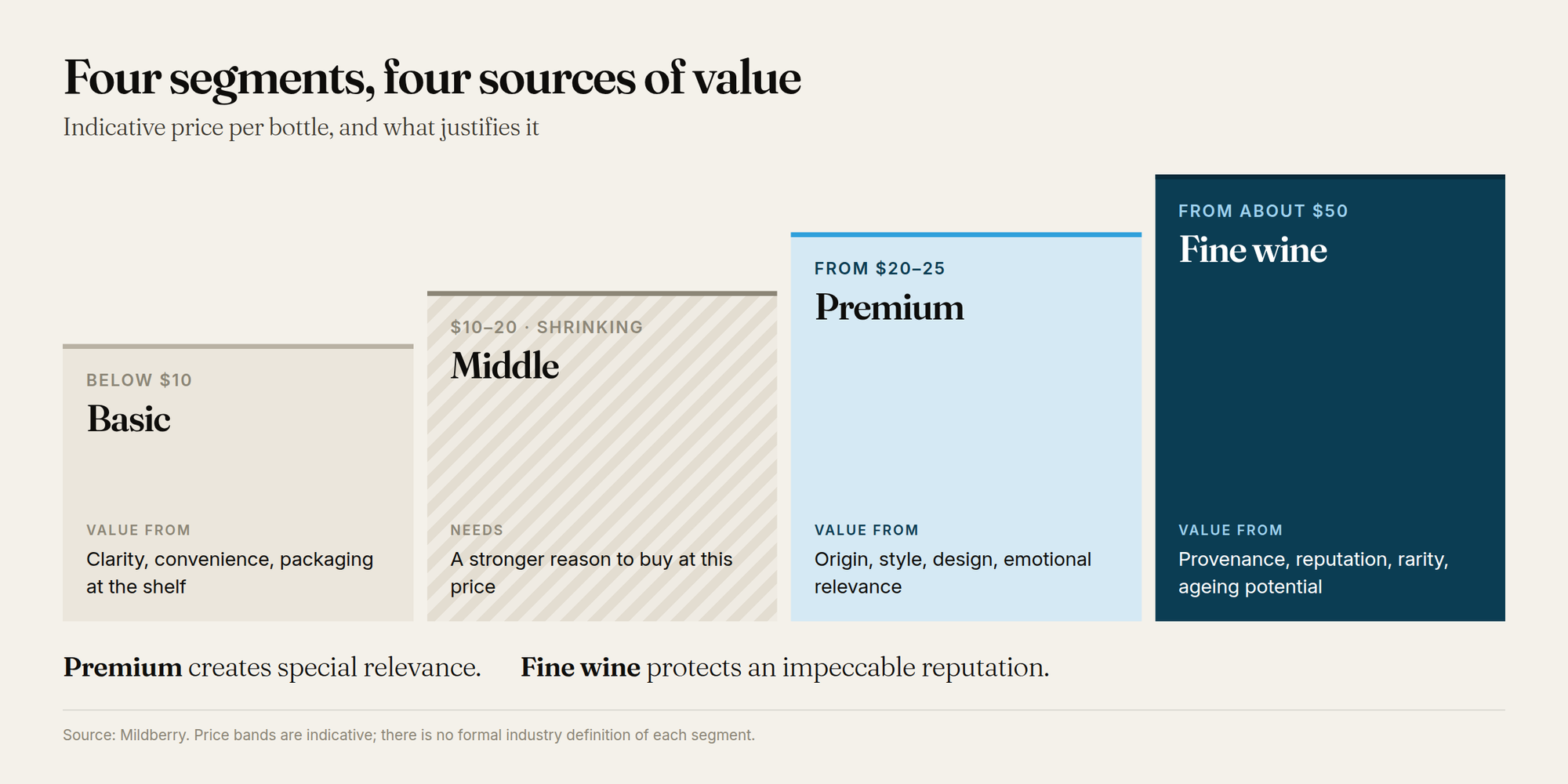
Thus, premium wines connect craftsmanship, design, and storytelling with contemporary lifestyles, while fine wines offer a deeper sense of confidence and trust, grounded in provenance, reputation, rarity, and expert service.
Premium creates special relevance. Fine wine protects an impeccable reputation.
Across all of these segments, marketing plays different roles—but its central task remains the same: turning all possible product attributes into a convincing reason to buy. The challenge is that if market players simply raise prices, they risk failure. They need to create additional value and make it visible and meaningful.
The strongest marketing opportunity lies in the projected growth of fine wine, with the market forecast to grow by 4–6% a year through 2030, according to Bain & Company and Altagamma. The forecast points to the potential of this value-led approach rather than proving that every premium proposition will succeed. However, projected growth is not a guarantee of performance. Brands still need help to justify their position through consistent quality, disciplined pricing, and relationships that extend beyond the transaction. The opportunity, as we saw in our wine projects, lies in creating more value through each wine’s distinctive brand and product attributes—not assuming that a higher price alone will create demand.
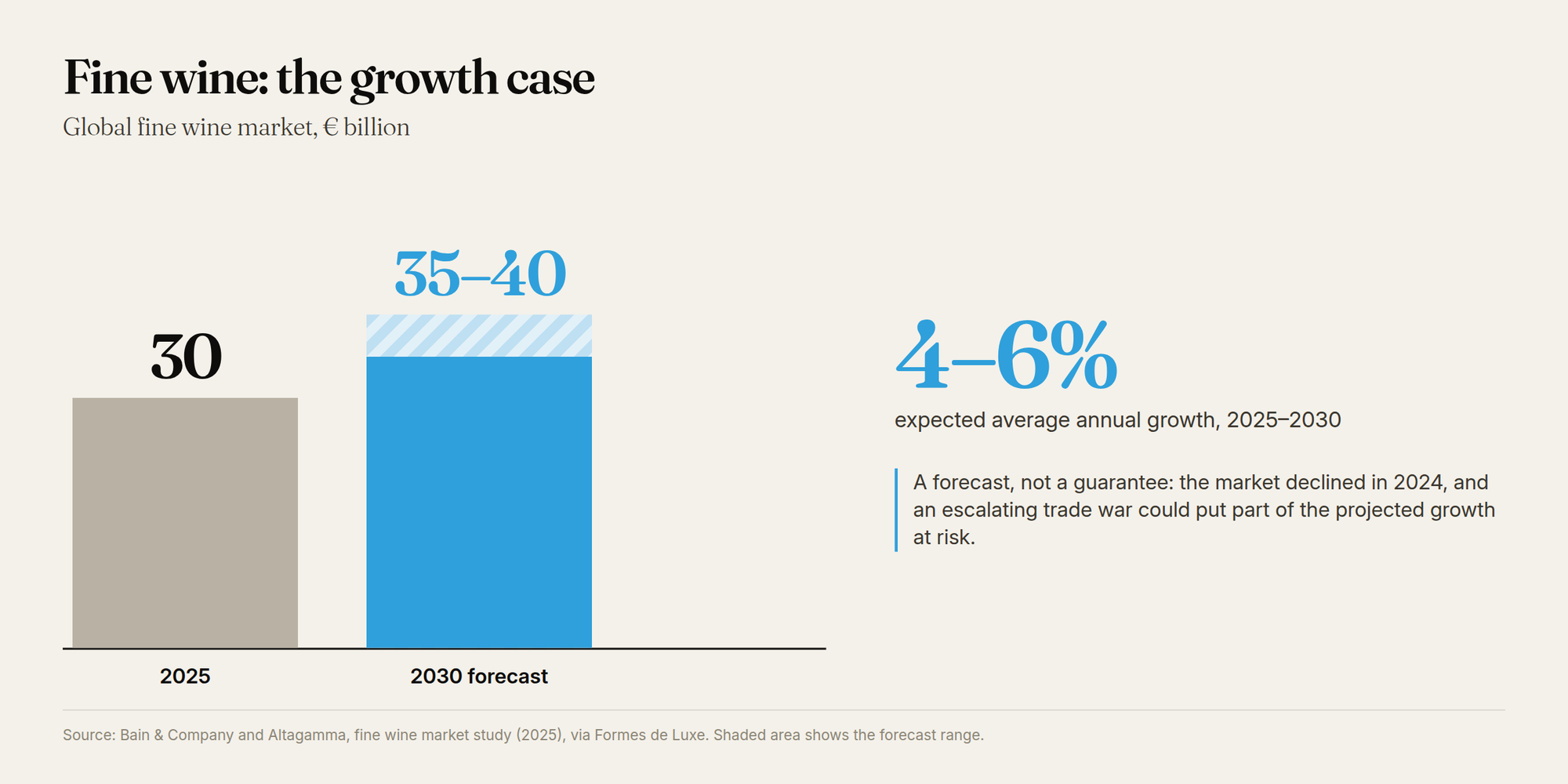
Value often exists beyond the product and the bottle. A higher price is never a positioning strategy in itself. Consumers need a clear, credible reason to pay more.
02
Five Lenses on Consumer Change
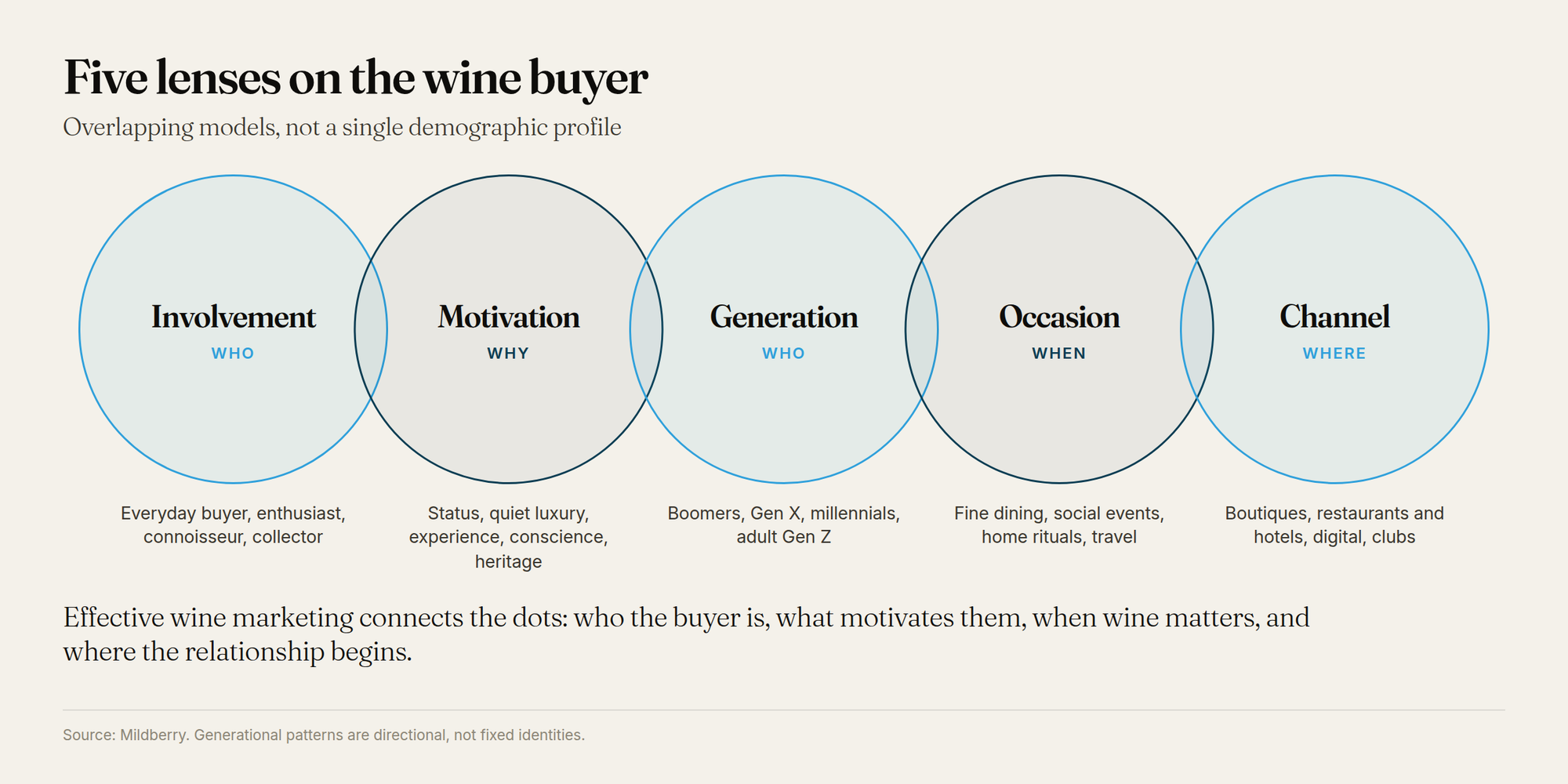
Wine audiences are best understood through overlapping models rather than a single demographic profile. Premium and fine-wine marketing brings together the key factors that explain what consumers value and how to reach them.
Involvement
Everyday buyers seek reliability and easy choice. Emerging enthusiasts want discovery and guidance into premium wine. Connoisseurs prioritize origin, producer style, and expert recommendations. Collectors focus on rarity, provenance, aging potential, and professional storage.
Motivation
Status seekers choose recognizable labels and impressive presentation. Quiet-luxury enthusiasts value craftsmanship and understated quality. Experience seekers connect wine with gastronomy, travel, and culture. Conscious consumers prioritize transparency, responsible production, and moderation. Heritage collectors seek history and lasting significance.
Generation
Baby boomers tend to value established producers, tradition, and trusted advice. Generation X looks for reputation and quality that justifies the price. Millennials respond to discovery, origin stories, and gastronomic experiences. Adult Gen Z consumers place greater emphasis on social context, moderation, and alternative formats. These are directional patterns, not fixed identities.
Occasion
Fine dining makes wine part of a curated gastronomic experience. Social events connect it with atmosphere and shared enjoyment. Home rituals turn it into a personal pleasure or everyday luxury. Travel and wine tourism connect the bottle with place, people, and local culture.
Channel
Wine boutiques build confidence through personal advice. Restaurants, bars, and hotels enable discovery through tastings and food pairings. Digital platforms simplify navigation and repeat purchases. Direct sales and clubs create ongoing relationships through curated selections, allocations, and privileged access.
Effective wine marketing connects the dots: who the buyer is, what motivates them, when wine matters, and where the relationship begins.
03
Expanding the Premium Advantage Beyond the Bottle
The most impactful marketing occurs when brands create immersive experiences and meaningful rituals, supported by subtle atmospheric details that leave a tangible, lasting impression. And it sells. Repeatedly.
Provenance Becomes Meaning
Premium wine is not always an instinctive purchase. Consumers may need to recognize its value before they can fully experience it—and then feel that the experience is worth the investment. A distinctive origin gives a premium bottle a credible identity and a story that helps consumers understand its quality. In premium wine, origin is more than geography. It can connect a bottle to a distinctive landscape, such as volcanic soils; to a producer’s philosophy; or to the history and heritage of an estate, family, or signature style. It can also explain taste through the mineral composition of the soil, vineyard conditions, or careful barrel aging. Marketing translates the language of vineyards, grapes, climate, and craft into something consumers can understand, feel, remember, and value.
Experience Makes Value Tangible
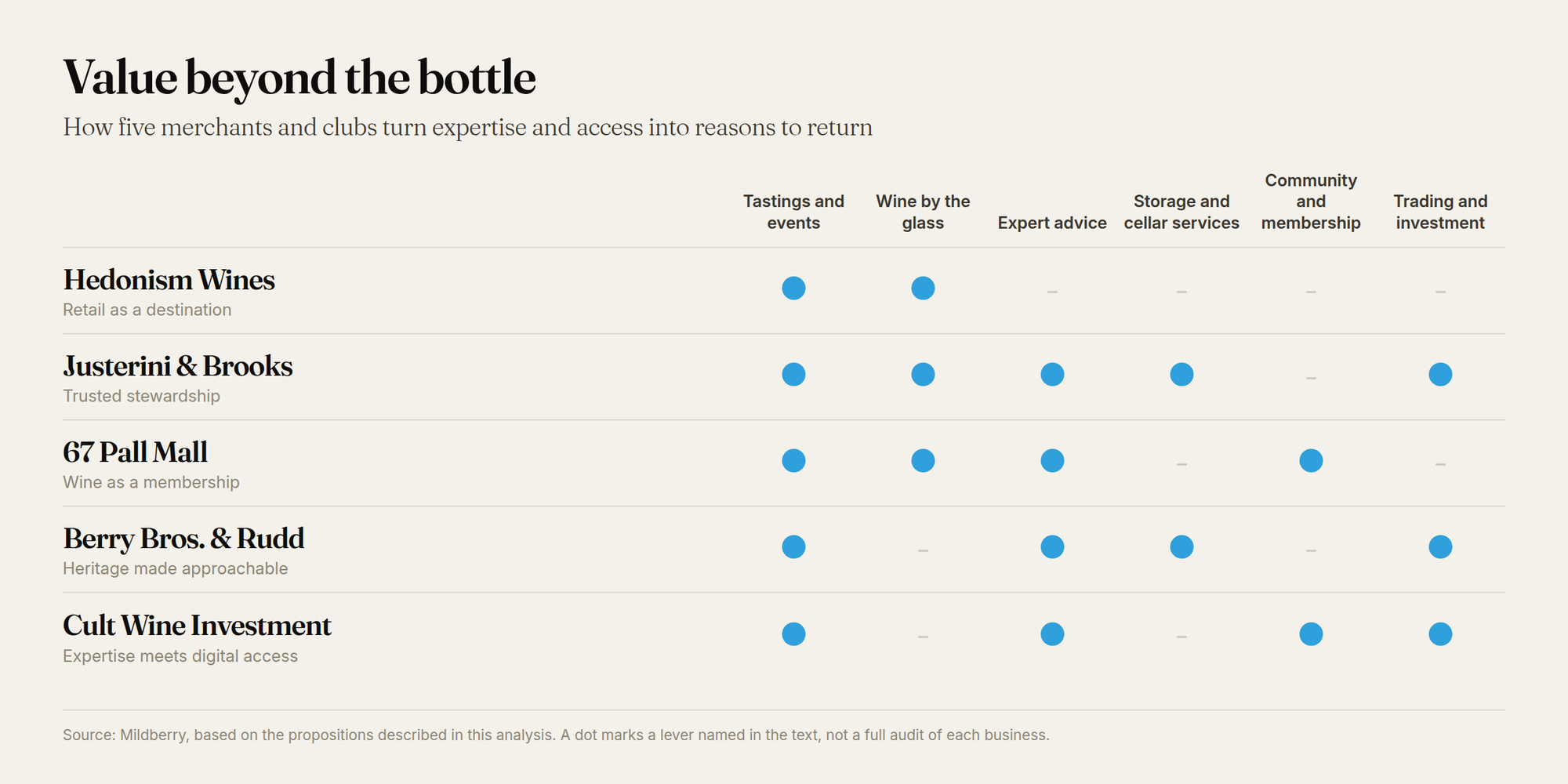
Premium wine can communicate quality through origin, reputation, and price, but experience turns those promises into something personal. The setting, the guidance, and the moment of discovery help consumers understand not only why wine is valuable, but why it matters to them. Hedonism Wines turns retail into a distinctive visual destination with a great selection. Justerini & Brooks connects rare wine with a pathway of discovery and enjoyment. 67 Pall Mall builds a personalized membership experience around expertise, gastronomy, and access.
These models show how spaces, tastings, and hospitality become marketing assets—not just sales channels. Let’s see how the experience becomes part of the proposition, giving consumers a reason to engage beyond the bottle itself.
Hedonism Wines: Immersive Discovery
Retail as a destination
Hedonism turns its Mayfair boutique into a wine showroom: backlit displays, sculptural bottle presentation, large formats, and seasonal installations make inventory visually compelling. The marketing effect is to make rarity tangible and turn browsing into an experience worth revisiting.
Exceptional inventory, accessible entry points
Rare vintages, producer verticals, and unusual formats coexist with affordable bottles. A 2023 profile counted around 640 wines below £30. This breadth creates an aspirational halo without excluding everyday buyers, allowing the same brand to meet customers’ needs for gifting, discovery, celebrations, and collecting.
Tasting as a bridge to purchase
By-the-glass discovery, producer-led events, and tailored tastings reduce the commitment required to explore expensive wines. Its connection with HIDE restaurant extends the assortment into dining occasions. The commercial logic is to turn curiosity into confidence—and confidence into purchase.
Justerini & Brooks: Trusted Stewardship
Heritage translated into advice
Justerini & Brooks marked its 275th anniversary in 2024, combining established authority with private-client expertise. Its advisory model helps customers understand producers, vintages, and collection choices: heritage becomes commercially relevant through guidance, not simply historical storytelling.
Ownership as an ongoing service
Professional storage, digital cellar access, valuations, delivery requests, and brokerage keep the merchant involved after purchase. Drinking-readiness labels help clients decide what to open, retain, or sell. This turns a bottle transaction into a long-term relationship built around managing a collection.
Access without losing prestige
The Burlington Arcade boutique’s 2024 launch combined expert advice, tasting spaces, and Coravin-served wines, with reported bottle prices ranging from £50 to £5,000. As a historical benchmark—not a claim about current operations—it shows how tasting can welcome new buyers while preserving fine wine’s authority and supporting deeper client engagement.
67 Pall Mall: Wine as a Membership Experience
The club as a brand
67 Pall Mall builds its proposition around a private members’ community devoted to wine, gastronomy, and discovery. The club makes wine a reason to belong—not simply something to order—connecting expert guidance with social interaction and hospitality.
Exceptional wines, smaller commitments
Extensive wine lists and hundreds of wines available by the glass, supported by Coravin, let members explore rare bottles without purchasing them outright. The marketing strength is accessible discovery within an exclusive setting: prestige comes from the quality of access, not only the price of a bottle.
Expertise that sustains engagement
Tastings, masterclasses, and the club’s wine-focused video platform extend the relationship beyond dining. Initiatives such as China Uncorked, showcasing Chinese wines in Hong Kong, make the club a curator of emerging regions as well as established icons. Education and discovery give members continuing reasons to engage.
04
Making Expertise More Accessible
Wine’s complexity can be fascinating, but it can also make consumers hesitate. Unfamiliar terroirs, vintages, and classifications can turn an expensive purchase into an uncomfortable test of knowledge. Effective premium marketing preserves that depth while making it more accessible. It replaces the pressure to know every detail with the confidence to discover something new alongside a trusted expert.
Berry Bros. & Rudd presents collecting as an approachable journey, supported by expert selection and cellar services. Cult Wine Investment uses contemporary language, design, and digital tools to make a traditionally conservative category easier to navigate, especially for younger newcomers.
Berry Bros. & Rudd: Heritage Made Approachable
Authority with accessible entry points
Berry Bros. & Rudd combines a history dating to 1698 with an offer spanning everyday wines, own-label selections, and collectible releases. Heritage reassures newcomers rather than excluding them: customers can enter through an affordable bottle and develop their taste within the same trusted brand.
Collecting as a guided journey
Its Cellar Plan and bespoke guidance help customers move from individual purchases toward a purposeful collection. The marketing strength is continuity: expert selection turns a complex category into an ongoing personal journey, connecting future purchases with taste, occasions, and cellar ambitions.
A complete ownership ecosystem
Tastings, cellar-building services, auctions, and the BBX fine-wine exchange extend the relationship beyond retail. The merchant remains relevant, whether customers want to discover, collect, drink, or sell—creating multiple reasons to return throughout ownership.
Cult Wine Investment: Expertise Meets Digital Access
Fine wine through an investment lens
Cult Wine Investment presents fine wine as a tangible asset supported by professional portfolio management. Selection is organized around clients’ risk appetite, investment horizon, and objectives, making a specialist market easier to navigate through a structured service.
Technology makes expertise visible
The company combines wine knowledge with data science, machine learning, and AI to analyze markets and identify opportunities. Its marketing proposition is clarity: digital access, portfolio information, and ongoing advice make expert decisions more understandable to clients.
Investment with a cultural dimension
Tastings, wine stories, expert-led learning, and an investor community add an experiential layer to portfolio ownership. The proposition connects financial interest with personal enjoyment—but investment returns are not guaranteed: wine values can fall, and selling may take months.
The principle is simple: expertise should increase confidence, not demonstrate superiority. Its value lies in helping consumers develop their own judgment—not making them feel dependent on someone else’s.
05
Innovation: New Ways to Engage with Wine
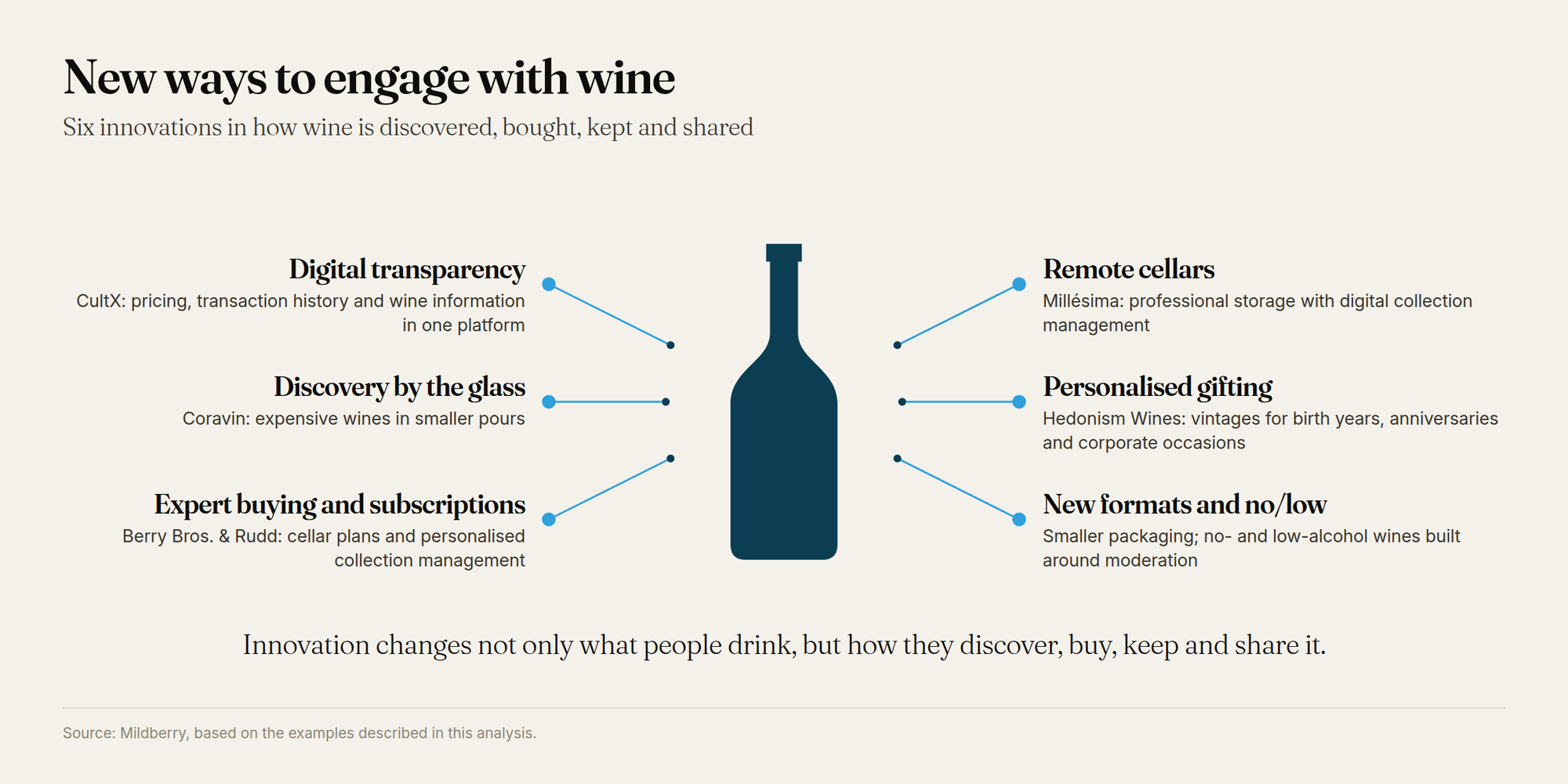
Many distinctive marketing innovations emerge in premium and fine wine, where complexity and higher prices create demand for guidance, reassurance, and service.
- Digital transparency. CultX brings pricing, transaction history, and wine information into one platform.
- Discovery by the glass. Coravin helps venues offer expensive wines in smaller pours, reducing the commitment required to explore them.
- Expert buying and subscriptions. Berry Bros. & Rudd offers cellar plans and personalized collection management, turning individual purchases into ongoing relationships.
- Remote cellars. Millésima combines professional storage with digital collection management, separating ownership from immediate delivery.
- Personalized gifting. Hedonism Wines connects vintages with people’s birth years, anniversaries, and corporate occasions by helping customers find wines from a specific commemorative year.
- New formats and no/low offers. Smaller packaging addresses serving needs, while no- and low-alcohol wines create opportunities around moderation.
Innovation changes not only what people drink, but how they discover, buy, keep, and share it.
06
The Final Sip
For accessible wine, the formula is straightforward: a clear proposition, easy-to-understand taste cues, recognizable design, and simple choice. For premium wine, the priority is a distinctive brand world that makes quality visible and connects it to meaningful occasions and lifestyles throughout the customer journey. For fine wine, the proposition is broader: a complete system of confidence and privileged experiences built around provenance, reputation, controlled access, a carefully designed setting for enjoying wine, and exceptional service.
The marketing opportunity grows with the segment and becomes more complex, connecting product, story, design, experience, and relationships into one coherent proposition. Wine’s transformation is not simply a move toward higher prices. It is a move toward more deliberate value creation, communicated most visibly by premium and fine-wine brands.
Strong wine brands go beyond what is in the bottle. They define why wine belongs in their customers’ lives.
In vino veritas, in valore futurum